Bank of Sierra Leone Sign Agreement With FG Gold to Purchase Gold From Baomahun Mine


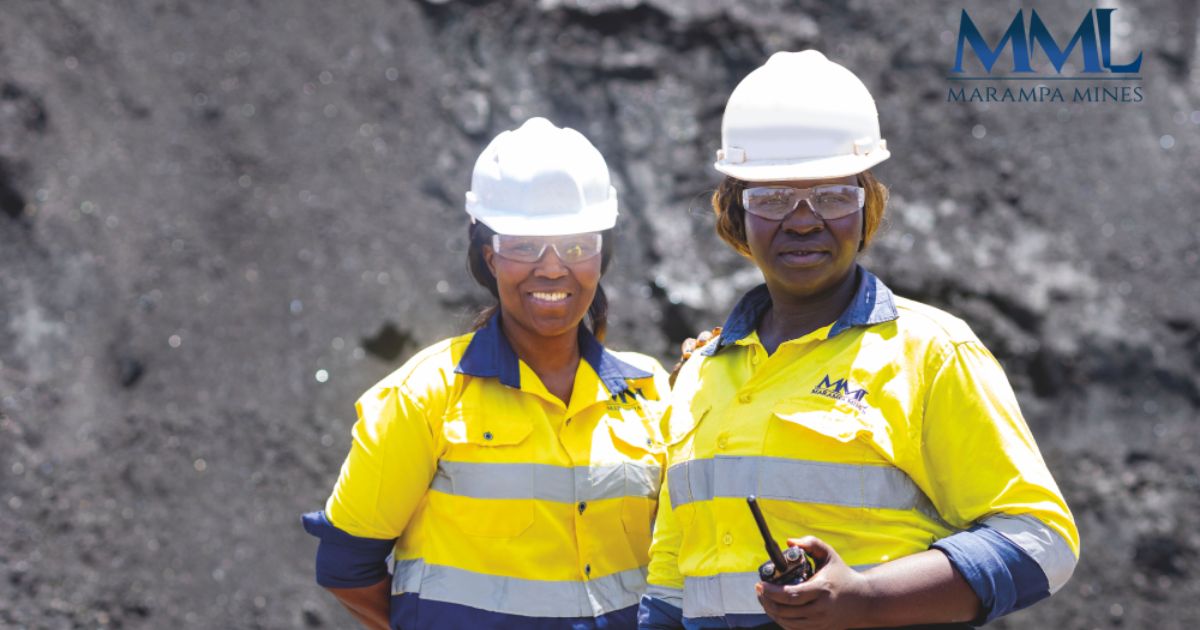
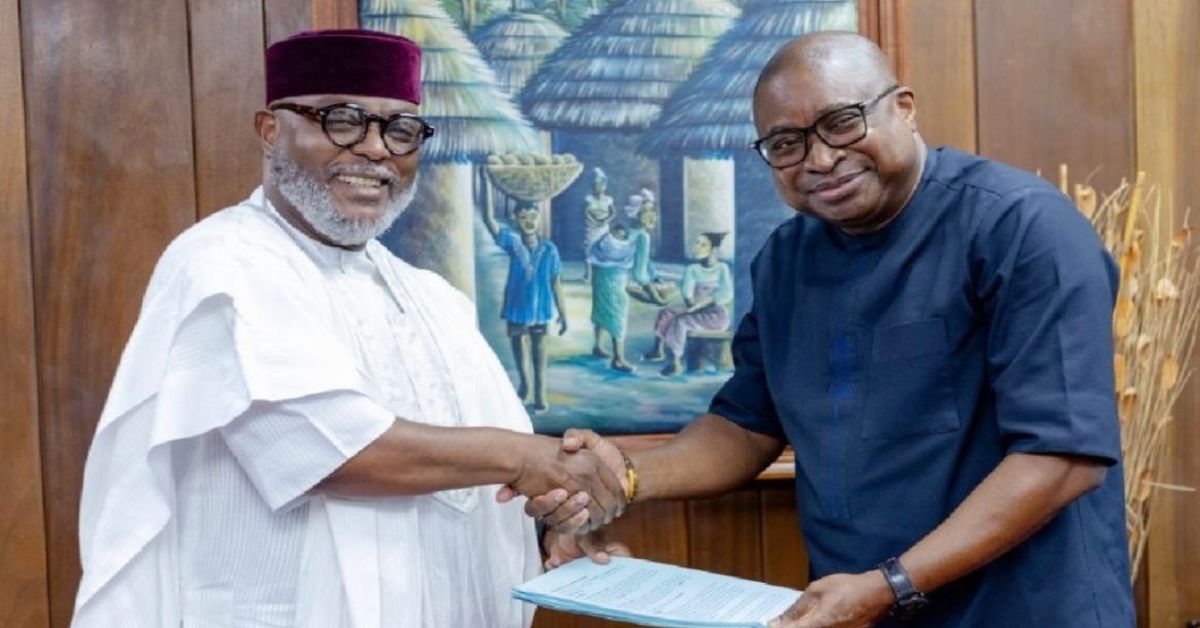
FG Gold Limited and the Bank of Sierra Leone have signed a Memorandum of Understanding for the central bank to purchase gold from the Baomahun Gold Project once commercial production begins.

The agreement establishes a framework for the Bank of Sierra Leone to buy gold produced at the large-scale mining project, with payments to be made in local currency, according to FG Gold.

The company said the arrangement represents the first offtake agreement between the central bank and a large-scale gold mine in Sierra Leone, creating a new channel for incorporating locally produced gold into the country’s reserves.

Baomahun, located in the southern part of Sierra Leone, is one of the country’s major mining investments. The National Minerals Agency lists FG Gold’s mining lease among Sierra Leone’s active mining agreements.

FG Gold said the project is valued at about $700 million and is expected to produce approximately 150,000 ounces of gold annually once operational.

The company said the planned purchases by BSL are intended to support the Bank’s Gold Purchasing Programme and strengthen the country’s gold reserves.

FG Gold Executive Chairman Oliver Tunde Andrews described the agreement as an important development for the company and Sierra Leone.

“We appreciate BSL’s confidence in us as a partner in its gold purchasing plan. This initiative will bolster Sierra Leone’s gold reserves and contribute to economic stability. We view this partnership as an opportunity to further strengthen the economy of Sierra Leone.”

The Bank of Sierra Leone has previously documented its plans to invest in gold and noted that the central bank has legal authority to buy and sell gold. Its financial statements also record the Board’s approval of a proposal for BSL investment in gold.

FG Gold said Baomahun is projected to contribute nearly 10% of Sierra Leone’s gross domestic product and create direct and indirect employment opportunities for up to 900 Sierra Leoneans. The company also said Sierra Leoneans already account for more than 90% of its workforce.

The company has undertaken several community and infrastructure initiatives ahead of production, including a tertiary education and skills-training fund, improvements to the 66-kilometer Matotoka access road, and projects aimed at strengthening trade and market connections.

FG Gold also cited the construction of St. Joseph Bakhita Primary School and the renovation of the Baomahun Health Centre among its community investments.

The company said major mine infrastructure, including a power plant, processing plant, tailings storage facility, accommodation camp and administrative buildings, is nearing completion.

The Ministry of Mines and Mineral Resources has previously described Baomahun as Sierra Leone’s first large-scale commercial gold mine, with a JORC-certified resource of 5.81 million ounces and expected annual production of 150,000 ounces over more than a decade.

The proposed gold purchasing arrangement comes as Sierra Leone seeks to expand the contribution of its mineral resources to national economic development and reserve management.


Source link

Chicken Town Sierra Leone Announces Price Adjustment Over Rising Commodity Costs


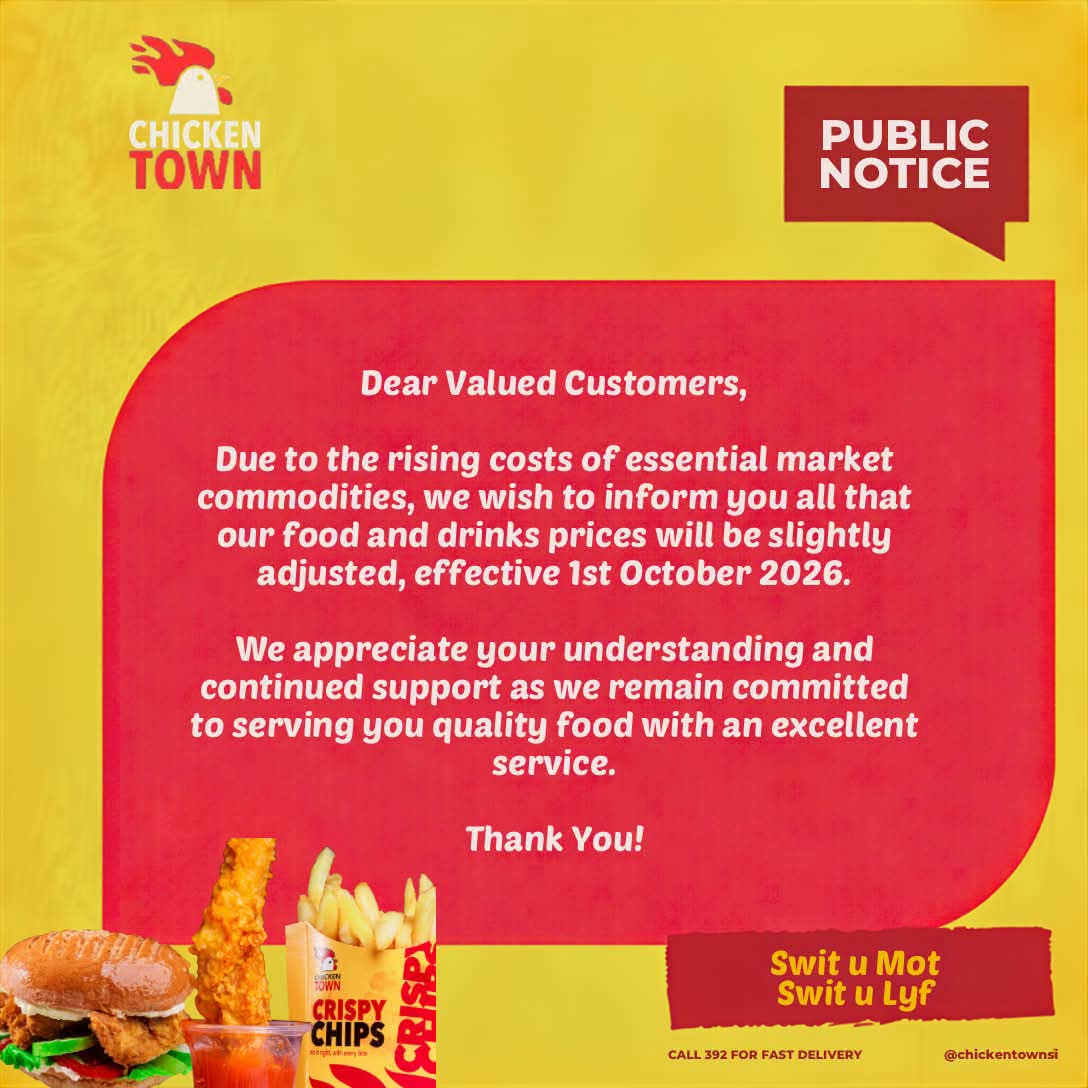
Chicken Town Sierra Leone has announced a slight increase in the prices of its food and drinks, effective Oct. 1, citing rising costs of essential market commodities.

In a customer notice, the food and beverage business said the adjustment is driven by continued increases in the cost of key ingredients and supplies used in its operations.

The new prices will take effect on Oct. 1, 2026. The company did not disclose specific percentage increases or a revised price list.

Management described the adjustment as modest, saying it reflects broader market pressures affecting food service businesses across the country.

Chicken Town Sierra Leone said it remains committed to maintaining quality food and service despite the price changes.

“We appreciate your understanding and continued support as we remain committed to serving you quality food and excellent service,” the notice stated.

Price adjustments among food vendors and restaurants have become common in urban areas of Sierra Leone, as businesses respond to fluctuations in commodity prices, transport costs, and supply chain pressures.


Source link

US$20 Million Financing Package Finalised to Boost Palm Oil Processing in Sierra Leone


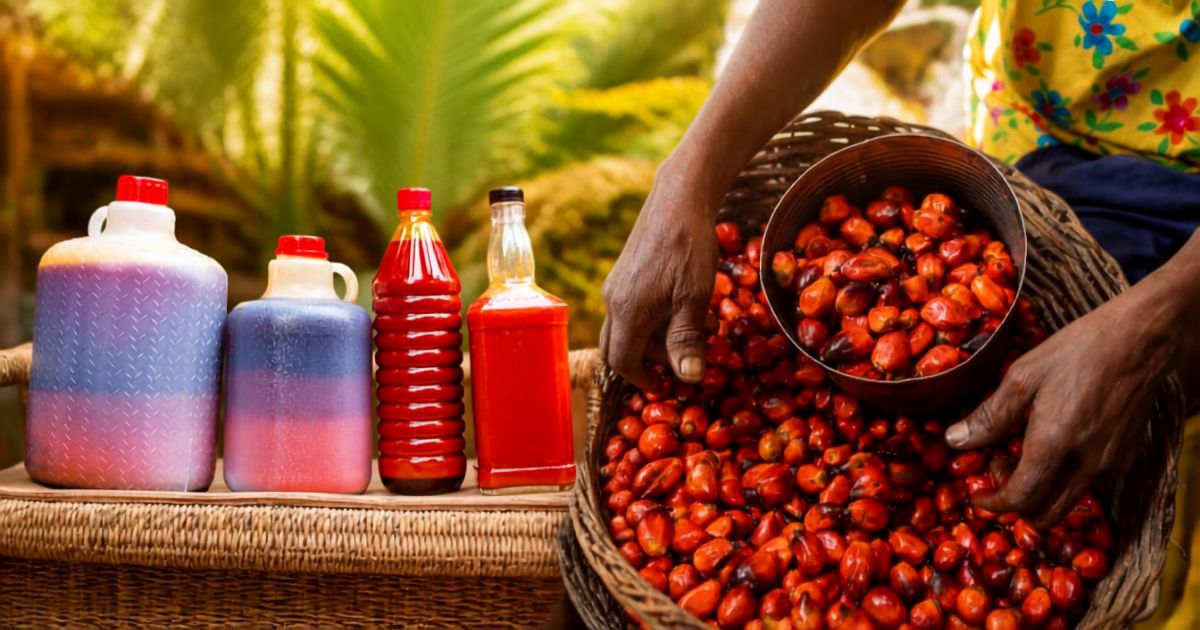
Sierra Leone’s palm oil processing sector has received a major boost following the finalisation of a US$20 million financing package from Proparco, the French development finance institution, aimed at expanding the operations of Jolaks Manufacturing Company Limited.

The financing, Proparco’s first direct investment in Sierra Leone, was secured under the Africa Resilience Investment Accelerator (ARIA) initiative and is now being implemented, according to details of the agreement first signed in November 2024. The loan will support the expansion of Jolaks’ existing refinery capacity, the installation of a biomass power plant, and strengthened links with local smallholder farmers.

Jolaks, a subsidiary of the family-owned Pee Cee Holding Ltd, currently processes up to 300 tonnes of crude palm oil per day at its Freetown refinery, converting it into refined cooking oil sold under brands such as Padi, as well as soap and by-products. The company employs more than 400 people and already supplies the domestic market while exporting to several ECOWAS countries.

Proparco’s Regional Director for West Africa, Sadio Dicko, described Jolaks as a “key player for the Sierra Leonean population,” noting that the financing would enable the company to process more palm oil locally and secure the supply of this staple commodity. ARIA Country Manager for Sierra Leone, Valerie Entsiful, said the company’s objectives were “very clear, both in terms of food security and creating jobs for young people in Sierra Leone”.

Minister of Agriculture and Food Security Henry Musa Kpaka stated that Sierra Leone has transitioned from being a net importer of vegetable oil to a net exporter, with palm oil production growing “by at least 8% to 10% every year”. He highlighted the tangible household impact, noting that the company’s success allows families to send their children to school and access sufficient food.

For local smallholder farmers, the expansion represents a more reliable market for their produce. Cecilia Jimmy, a farmer who has supplied Jolaks since 2001, said the company “pays us a good price, so we always come back to them”. The increased capacity is expected to encourage higher production and reduce post-harvest losses that have historically plagued rural producers with limited market access.

The investment aligns with the government’s broader objectives of job creation, import substitution, and agricultural self-sufficiency. Minister of Trade and Industry Alpha Ibrahim Sesay noted the country’s commitment to attracting investment in agriculture and related sectors.

The Jolaks project is part of a wider push by the Pee Cee group, which also operates large-scale onion farming and processing in Lungi under the government’s Feed Salone initiative.

With increased local processing capacity, Jolaks is positioned to reduce Sierra Leone’s foreign-exchange leakage from vegetable oil imports while strengthening the link between rural farming communities and the national market.


Source link

Father-Daughter Duo From Sierra Leone Secure U.S. Patent for Groundbreaking Fractal Grid Invention


A U.S. patent application for a data-organising method called Fractal Gridding, filed by Sierra Leonean-born inventor Rodney Kuhn King and his daughter Ecy Femi King, remains pending before the United States Patent and Trademark Office, according to agency records. The application, published as US20240095226A1, describes “methods and related devices for storing and accessing data using multi-level fractal grids”.

The filing, submitted in September 2023, lists both Kings as inventors and claims priority to a provisional application filed in September 2022. Google Patents currently shows the application’s legal status as “Pending,” not granted.

The Fractal Grid is a visual tool that arranges information in a hierarchical, nine-cell grid structure designed to mirror how the brain organises data. Rodney King has described it as a “visual tool to organise information in a brain-friendly manner”. He first filed a related application for “Fractal Grid Hierarchical Presentation of Information” in 2007.

Rodney King attended the Prince of Wales School in Freetown, where he was Head Boy in 1976, and graduated from Fourah Bay College in 1980 with a civil engineering degree. He later earned a master’s in infrastructure planning from the University of Stuttgart and lectured at Bell College of Technology in Scotland before moving to the United States in 2003.

Ecy King, born in Scotland and raised in California, studied at Stanford University and is a fellow at Harvard’s Centre for Digital Thriving. She has authored three Fractal Grid comic books, including “Bit by Bit,” published by Stanford University Press.

The application’s publication has drawn attention in Sierra Leonean media, where the invention has been framed as a source of national pride. However, the USPTO has not yet issued a final decision on the patent’s claims.

Attempts to independently verify several biographical claims in recent media coverage—including the assertion that a Dr William Fitzjohn served as King’s lecturer at Fourah Bay College—were unsuccessful. Public records identify a William Henry Fitzjohn who taught at the college in the 1950s, decades before King’s enrollment.


Source link

QCell Launches New 035 Number Series to Expand Connectivity in Sierra Leone


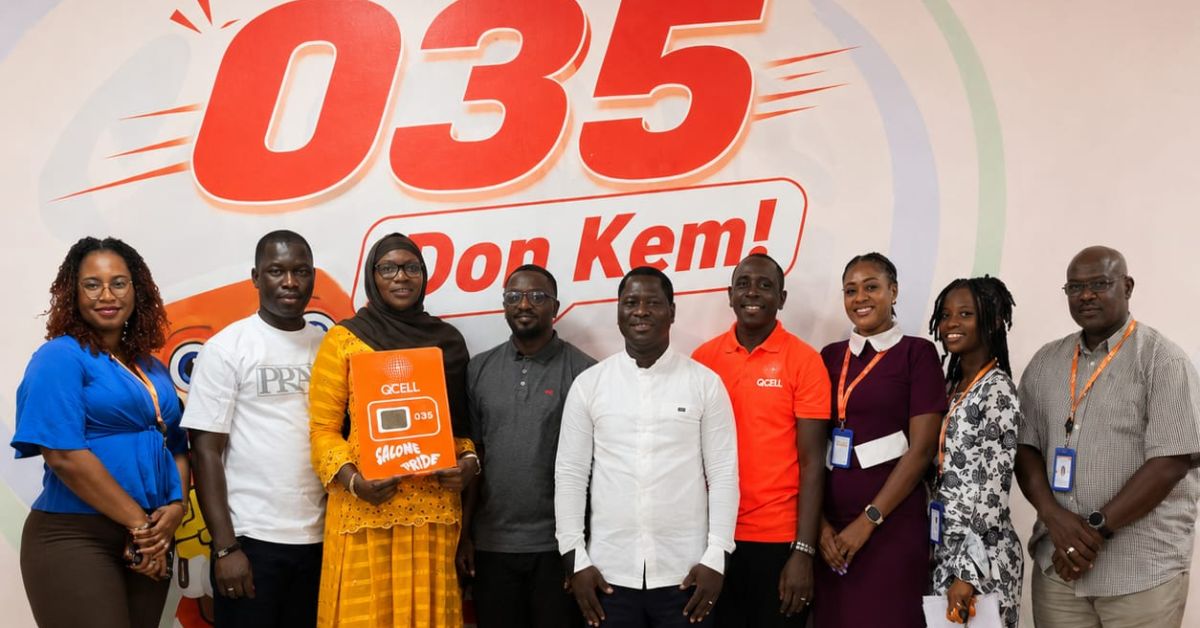
QCell mobile telecommunications network has launched a new 035 mobile number series at its headquarters in Freetown, introducing an initiative aimed at expanding customer choice and meeting the growing demand for telecommunications services across Sierra Leone.

The move comes as the company seeks to strengthen digital inclusion and enhance access to mobile connectivity in an increasingly technology-driven economy.

The launch includes a six-month promotional package for customers who activate the new 035 SIM cards, offering 10 minutes of voice calls, 300MB of data, and 100 SMS, designed to encourage adoption and improve user engagement with QCell’s network.

Speaking at the event, QCell Chief Executive Officer Karthik Jayamani said the new number series reflects the company’s commitment to innovation, adding that it allows customers to select numbers that align with their personal identity. Head of QMoney, Gabriel Mendy, highlighted the broader significance of the initiative, noting that it strengthens the integration between telecommunications services and mobile financial solutions, thereby supporting financial inclusion.

Head of Marketing Edward Nelson demonstrated the process of acquiring the new numbers, explaining that customers are required to present a valid national identification card for registration, in line with regulatory standards. Addressing concerns around security, Mendy emphasised that QMoney operates under strict Know Your Customer protocols and maintains a strong record of safeguarding users.

As the only African-owned telecommunications company in Sierra Leone, QCell has continued to expand its footprint in the country’s digital sector, including recent investments such as the rollout of 5G services in Freetown.

The introduction of the 035 series forms part of its broader strategy to scale operations and respond to increasing demand for reliable and accessible telecom services nationwide.


Source link

Oil Prices Drop By More Than 9% After US, Iran Pause Attacks


The price of oil has fallen sharply after the United States and Iran paused attacks, raising hopes that the conflict between the two countries may calm down.

Brent crude oil, which is used as a global price guide, fell by more than 9% after rising above $100 per barrel last week.

The drop happened after both countries announced that attacks had stopped temporarily to allow possible talks.

The conflict had caused oil prices to rise because of fears that oil supplies could be affected, especially through the Strait of Hormuz, an important route for transporting oil around the world.

Oil prices had earlier fallen after efforts to reduce the conflict, but they increased again when fighting restarted, and concerns about energy supplies grew.

By Monday, oil prices were still lower, but experts warned that the situation remains uncertain because the conflict could change at any time.

Analysts said countries are watching the situation closely because continued tensions could affect fuel prices and global energy supplies.


Source link

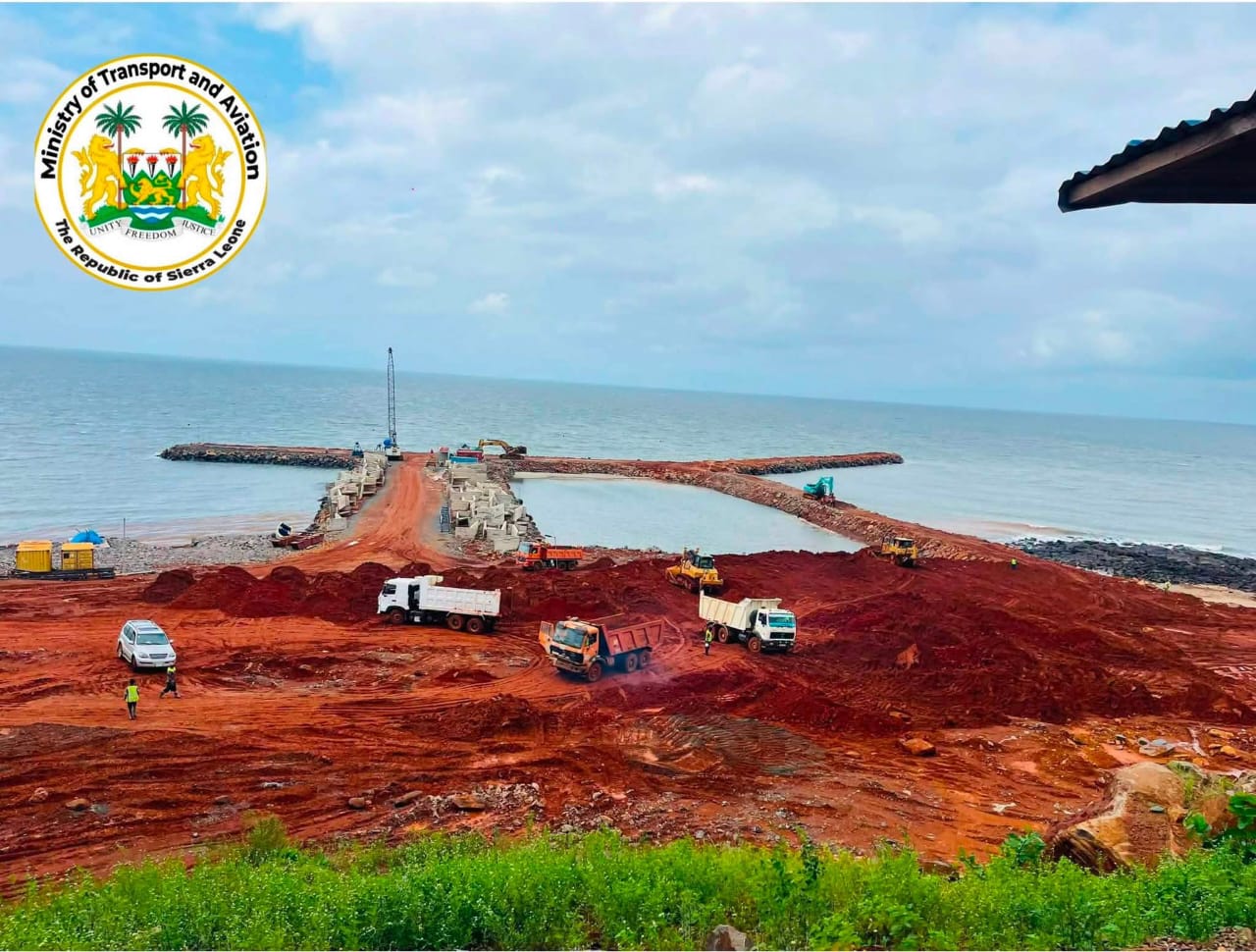
New Kent Dry Port to Reduce Cargo Pressure at Water Quay


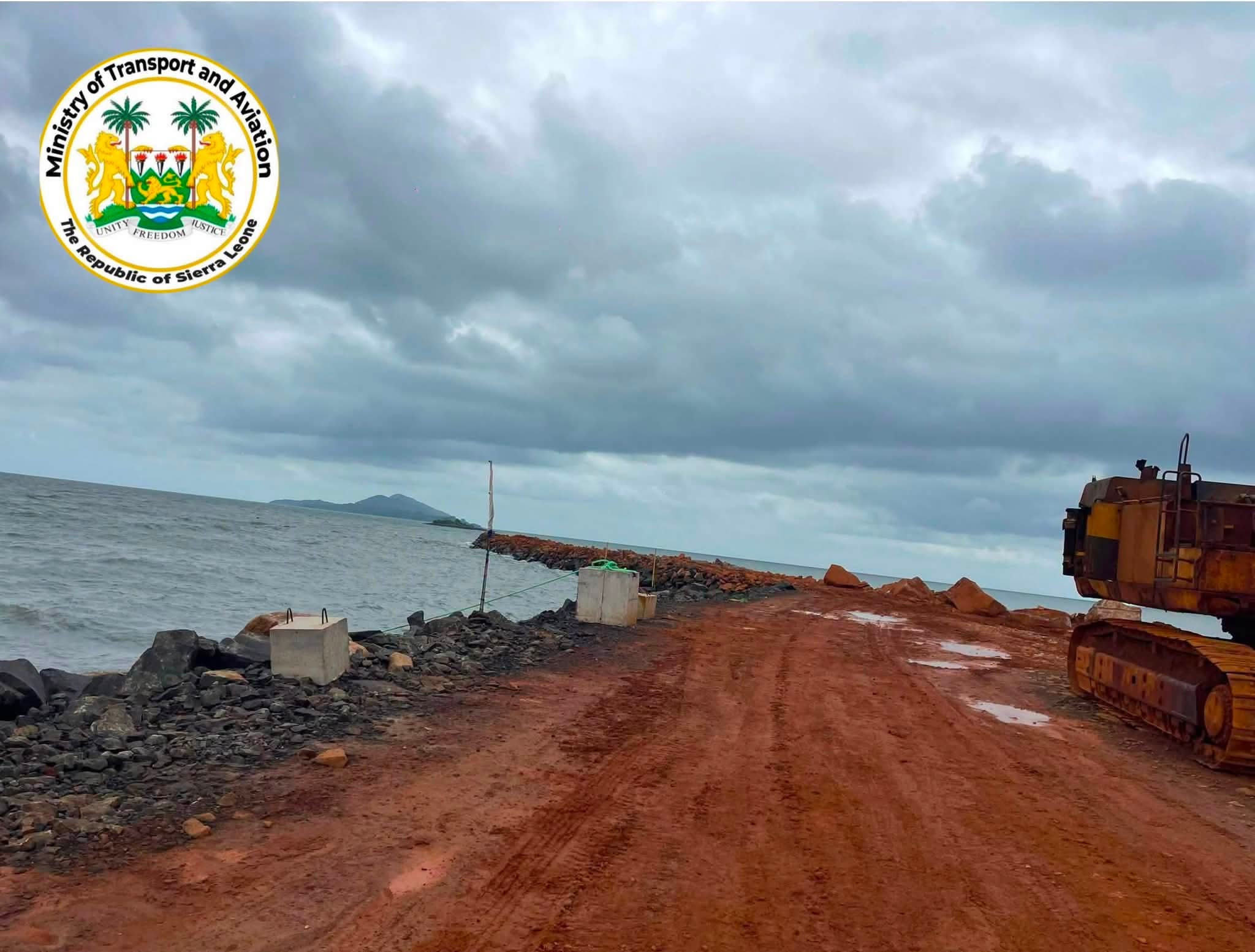
The development of a new dry port facility at Kent is expected to reduce cargo pressure at the Queen Elizabeth II Water Quay in Freetown. Constructed by Gento Group, the dry port will ease pressure on existing port facilities, and create new economic opportunities as the country expands its maritime infrastructure.

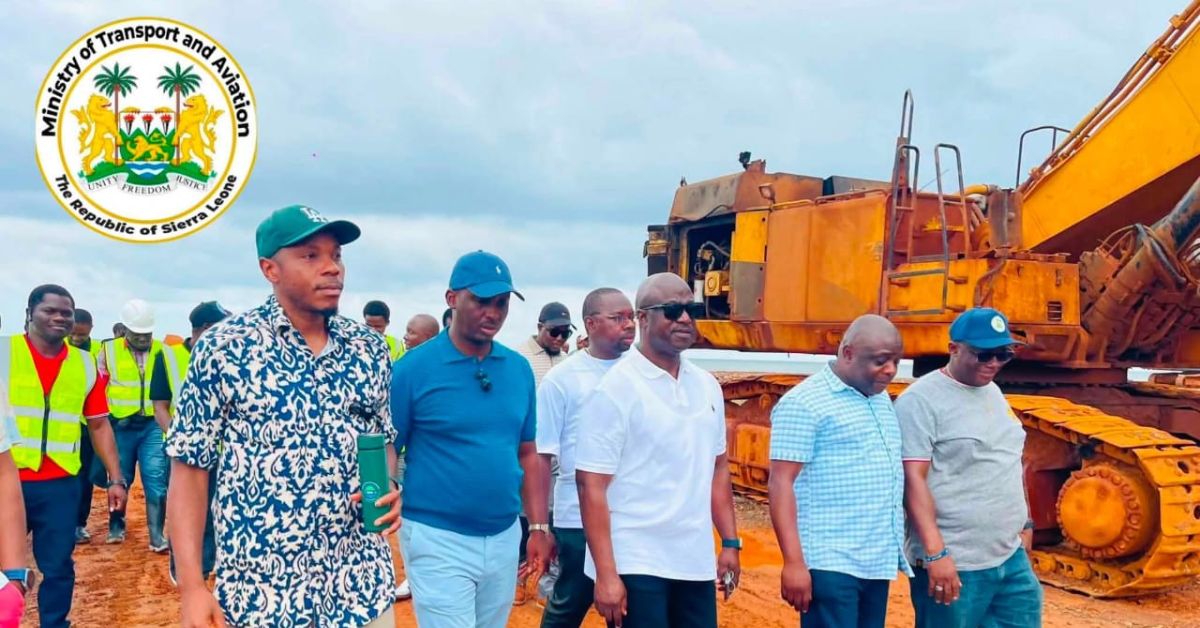
The project came under review on Saturday, 25 July 2026, when Chief Minister Dr. David Moinina Sengeh and Minister of Transport and Aviation Ambassador Col. (Rtd.) Alhaji Fanday Turay Esq. inspected the Gento Group’s Dry Port Project in Kent, Freetown.

The inspection highlighted the government’s continued focus on improving infrastructure through partnerships with private investors to support trade, transportation, and economic development.

During the visit, Chief Minister Sengeh described the project as a major step towards transforming Sierra Leone’s port and logistics landscape. He said the development reflects the government’s vision of turning investment commitments into practical projects that deliver national benefits.

He praised the collaboration between the government and Gento Group, noting that the project demonstrates growing confidence in Sierra Leone’s economy.

Gento Group Chief Executive Officer Mohamed Gento Kamara said the company’s operations are already providing employment opportunities, with more than 600 workers engaged, most of whom are Sierra Leoneans. He added that the company is working with technical partners while ensuring environmental standards are maintained.


The Kent Dry Port is expected to help reduce congestion at the Queen Elizabeth II Quay by providing additional space for cargo handling as trade volumes increase. Officials believe the facility will improve efficiency, lower business costs, and support economic growth.

Minister of Transport and Aviation Ambassador Col. (Rtd.) Alhaji Fanday Turay Esq. said the government remains committed to developing a modern transport system capable of supporting investment and strengthening Sierra Leone’s position within the regional maritime sector.

He noted that projects such as the Kent Dry Port, alongside other maritime initiatives, are part of wider efforts to create jobs, improve trade networks, and unlock the country’s economic potential.

The inspection reflects the government’s continued engagement with major infrastructure projects aimed at building a stronger and more competitive logistics sector for Sierra Leone.


Source link

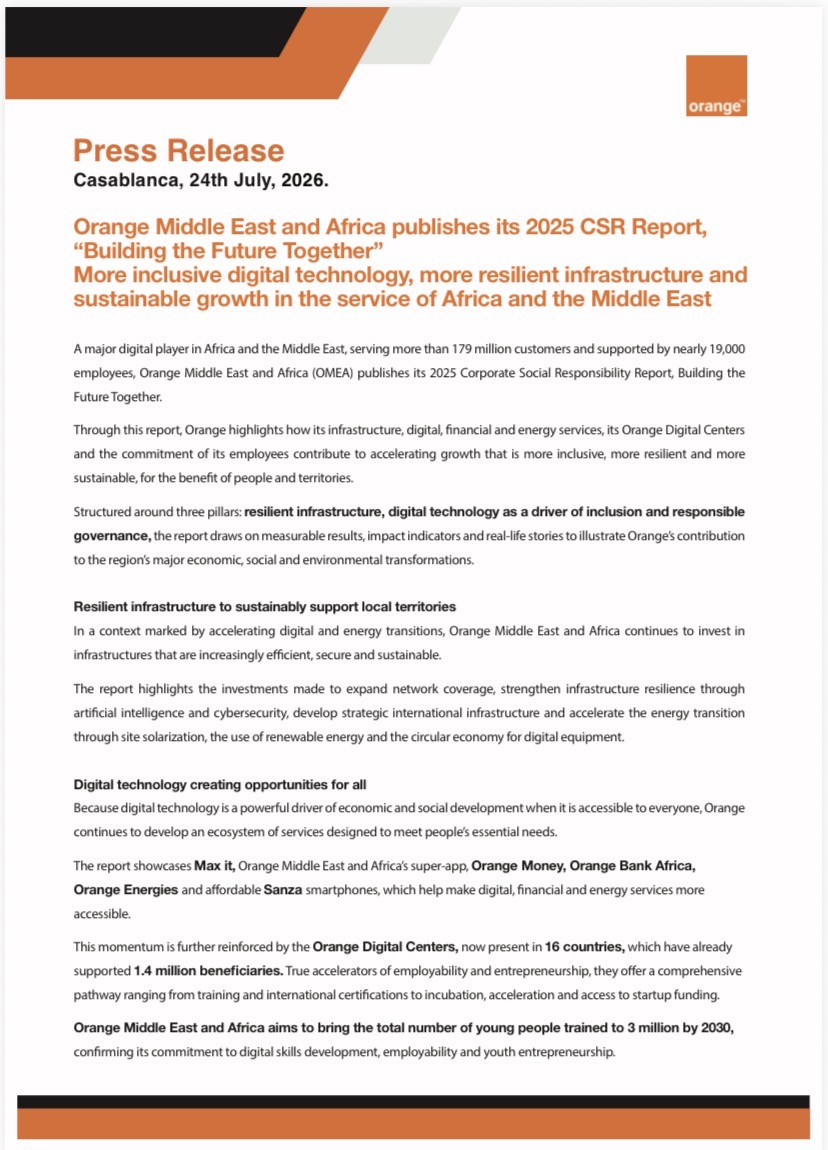
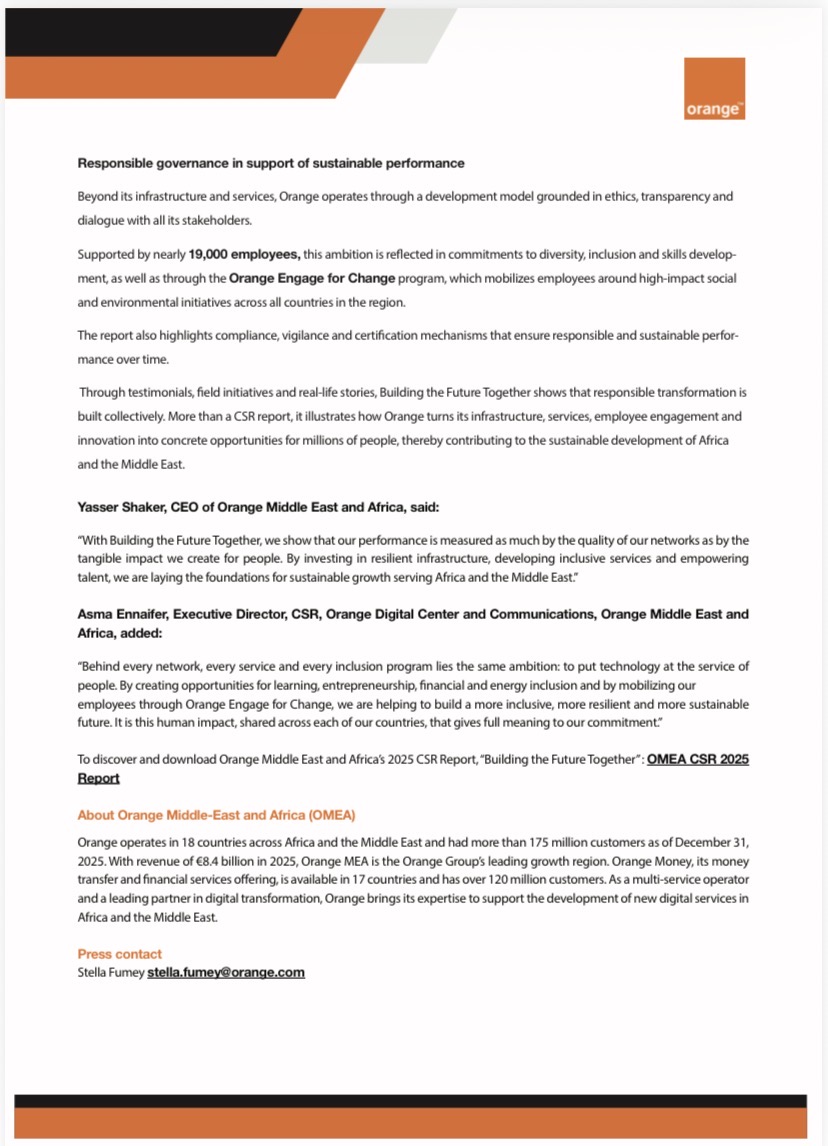
Orange Middle East and Africa Unveils 2025 CSR Report on Inclusive Growth


Orange Middle East and Africa (OMEA) has published its 2025 Corporate Social Responsibility (CSR) Report, titled Building the Future Together, highlighting the company’s continued investment in digital inclusion, resilient infrastructure and sustainable development across Africa and the Middle East.

The report outlines Orange’s efforts to promote inclusive economic growth through expanded digital, financial and energy services while strengthening infrastructure and advancing responsible corporate governance.

Serving more than 179 million customers across 18 countries and supported by nearly 19,000 employees, Orange said its strategy is centred on building resilient infrastructure, expanding access to digital opportunities and maintaining high standards of ethics, transparency and sustainability.

According to the report, the company continues to invest in stronger and more secure telecommunications infrastructure through artificial intelligence, cybersecurity, renewable energy solutions and the expansion of network coverage. It also highlighted initiatives aimed at reducing environmental impact, including the increased use of solar-powered sites and the adoption of circular economy practices for digital equipment.

Orange also showcased the expansion of its digital ecosystem through services such as Max it, Orange Money, Orange Bank Africa, Orange Energies and affordable Sanza smartphones, which are designed to improve access to digital, financial and energy solutions for millions of people across the region.

A major focus of the report is the impact of the Orange Digital Centres, now operating in 16 countries. The centres have supported approximately 1.4 million beneficiaries by providing digital skills training, internationally recognised certifications, entrepreneurship programmes, business incubation and access to startup funding.

Orange said it aims to increase the number of young people trained through the initiative to three million by 2030, reinforcing its commitment to youth employability, entrepreneurship and digital skills development.

The report also highlights the company’s emphasis on responsible governance through diversity and inclusion initiatives, employee development programmes and the Orange Engage for Change initiative, which encourages staff to participate in social and environmental projects across the region.

Commenting on the report, Orange Middle East and Africa Chief Executive Officer, Yasser Shaker, said the company’s success is measured not only by the strength of its networks but also by the positive impact it creates for communities.

He said continued investments in resilient infrastructure, inclusive services and talent development are laying the foundation for sustainable growth across Africa and the Middle East.

Executive Director for CSR, Orange Digital Centre and Communications at Orange Middle East and Africa, Asma Ennaifer, said the company’s ambition is to place technology at the service of people by creating opportunities for learning, entrepreneurship, financial inclusion and access to sustainable energy.

She added that employee engagement and community-focused initiatives remain central to Orange’s vision of building a more inclusive, resilient and sustainable future throughout the region.

Orange Middle East and Africa reported revenue of €8.4 billion in 2025 and said Orange Money, now available in 17 countries, serves more than 120 million customers, reinforcing the company’s position as one of the region’s leading digital transformation partners.

Screenshot

Screenshot


Source link

ECOWAS Leaders Reaffirm 2027 Launch for ‘ECO’ Single Currency at Freetown Summit


West African leaders have reaffirmed their commitment to launching the long-awaited single currency, the ECO, in 2027 as a key instrument for deepening regional economic integration.

The decision was contained in the final communiqué of the 69th Ordinary Session of the ECOWAS Authority of Heads of State and Government, held on July 19 in Freetown.

The Authority resolved that the launch of the ECO shall commence with those countries that meet the established macroeconomic convergence criteria and are ready to participate. Countries not yet ready will receive appropriate support to facilitate their subsequent accession to the single currency.

To qualify for the monetary union, member states must meet benchmarks including maintaining a budget deficit of no more than 3 percent of GDP, keeping annual inflation below 10 percent, and holding gross external reserves equivalent to at least three months of import cover.

The first phase of implementation is expected to involve Sierra Leone, Liberia, Nigeria, Ghana, Guinea, and The Gambia, subject to compliance with the agreed criteria and finalization of institutional governance structures.

The Authority further directed the ECOWAS Commission to intensify consultations with Central Bank Governors to formulate consensual proposals on outstanding issues essential for the currency’s introduction. It also welcomed the registration of the name “ECO” with the African Intellectual Property Organisation (OAPI) and directed its registration with other relevant international bodies.

Additionally, the Authority approved a request from the Republic of Guinea to join the Presidential Task Force on the ECOWAS Single Currency Programme. The Commission is instructed to convene a meeting of this expanded Task Force prior to the next Ordinary Summit in December 2026, working in collaboration with the President of Côte d’Ivoire, who currently serves on the task force.

The push for the ECO, a decades-old ambition that has faced multiple delays, mirrors aspects of the European Union model and aims to reduce exchange rate risks, cut transaction costs for businesses, and stimulate trade across West Africa .


Source link

AfDB Renews Budget Support Engagement with Sierra Leone After Three-Year Suspension


The African Development Bank (AfDB) has concluded a 10-day Policy-Based Operation Appraisal Mission in Sierra Leone, marking renewed cooperation on budget support after a three-year suspension.

The mission concluded with a meeting on Thursday, July 16, with Financial Secretary Matthew Dingie, where officials reviewed progress on key reforms, prior actions, and requirements needed for consideration by the AfDB Board.

Dingie expressed appreciation to the AfDB for its continued support, noting that the renewed engagement would contribute to Sierra Leone’s fiscal management and development priorities.

Chief Economist Alimamy Bangura said the mission was a follow-up assessment of progress made on agreed reforms and triggers under the 2026 and 2027 programmes. He added that discussions with Ministries, Departments, and Agencies were thorough and aimed at ensuring readiness for implementation.

Senior Governance Officer Andara Kamara outlined the reform measures required for the 2026 disbursement of $11.5 million, expected between September and November.

The measures include strengthening fiscal efficiency, transparency, and accountability; advancing inclusive and sustainable reforms in the mining and transport sectors; submitting the Public Financial Management Strategy; implementing audit recommendations; approving and launching the MAPS II implementation plan; introducing the Sierra Leone Critical Minerals Strategy; and securing Cabinet approval for the National Transport Sector Policy, which covers urban mobility, traffic management, and e-mobility.

Kamara said the required actions are already at an advanced stage and are expected to be completed before the scheduled disbursement.

For the 2027 programme, the agreed reform targets include drafting amendments to the Public Debt Management Act of 2011, deploying the GoAML system at the Financial Intelligence Unit, securing Cabinet approval of the revised Public Procurement Act of 2016, and approving the draft Beneficial Ownership Disclosure Regulation.

Financial Secretary Dingie expressed confidence that the 2026 Cabinet-level policy actions would be completed without delay, noting that legislative reforms usually require more time due to the approval process.

The AfDB mission was led by Senior Governance Officer Andara Kamara and included Ibrahim Bangura, Principal Governance Officer; Prosper Charle, Senior Country Economist; Philip Doghle, Regional Financial Management Coordinator; Kombo Koroma, Financial Management Specialist; Douglas Tsise, Procurement Specialist; Alex Yeanay, Senior Fragility Expert; Betty Wangozi, Chief Gender Specialist; and other officials.

The conclusion of the mission reinforces the renewed partnership between Sierra Leone and the AfDB, with the support expected to strengthen fiscal reforms, governance, and sustainable economic development.


Source link