Monetary Policy and Sustainable Development in Sierra Leone


Sierra Leone faces a difficult trade-off: inflation is rising while growth is slowing, reserves are thin and households are under pressure. The Bank of Sierra Leone’s decision to raise the Monetary Policy Rate (MPR) by 0.25 percentage points to 17.25 per cent signals vigilance. The key question is how well this tool fits the causes of inflation.

Statistics Sierra Leone reported annual inflation of 15.66 per cent in August 2026, up from 14.89 per cent in July. The Bank’s September statement links rising prices to food supply constraints, climate conditions, tax measures and global energy costs. It also reports slower growth, a widening trade deficit and reserves covering 1.8 months of imports.

What the MPR can do

A higher policy rate can make borrowing more expensive, restrain credit and moderate spending. If demand grows faster than the economy’s ability to supply goods and services, this can ease price pressures. It may also shape expectations: when businesses expect inflation to continue, they may raise prices in advance. Milton Friedman’s work highlights the importance of expectations and the limits of using monetary expansion to keep output above its sustainable level.

The Bank also cites private-sector credit growth of 52.2 per cent, above the programme target. If credit finances consumption, foreign-exchange demand or speculation faster than productive capacity expands, tighter monetary conditions may reduce these pressures.

However, these effects depend on policy transmission. The Bank identifies reserve money as its operating target and broad money as an intermediate target. It should explain how the MPR increase is expected to affect liquidity, lending and prices. A policy rate does not directly set every commercial lending rate, and many informal businesses do not borrow from banks.

What the MPR cannot do

Higher rates can raise working-capital costs, discourage investment and make it harder for farmers, traders and manufacturers to finance production. If firms that could expand food and essential-goods supply lose access to credit, tighter policy may weaken output without relieving the shortages driving prices.

Keynesian theory explains how interest rates affect borrowing, investment and spending, but these effects take time and vary across households and firms. The Phillips curve offers a related caution: weaker demand may ease demand-driven inflation, often at a cost to output and employment. Yet when prices rise because food, fuel or transport costs increase, lower domestic spending cannot quickly reverse them.

The Bank projects growth slowing from 4.8 per cent in 2025 to 4.0 per cent in 2026. It also reports non-performing loans at 10.2 per cent, above the stated regulatory ceiling. Tighter credit may curb imprudent lending, but an indiscriminate squeeze could weaken viable firms and worsen repayment problems. Credit growth alone does not show whether lending supports productive investment. The Bank should report which sectors borrow and how they use the funds.

Why Sierra Leone’s structure matters

Monetary analysis is necessary but incomplete. Raúl Prebisch’s structuralist approach highlights dependence on primary exports, exposure to external price movements and limited domestic capacity to supply essential goods. It helps explain why monetary tightening can have different effects in an import-dependent economy than in a diversified industrial one.

The IMF’s June 2026 assessment said spillovers from the Middle East conflict were weighing on Sierra Leone’s economy. It also noted low reserve coverage, climate exposure and debt risks, projected 4 per cent growth for 2026, and stressed the need to protect critical social spending.

Externalities and external shocks should not be confused. An externality is a cost or benefit imposed on people outside a transaction; pollution from fuel use, for example, can harm others. Global oil prices, shipping disruptions and imported-food costs are better described as external shocks or spillovers. They raise import, transport and production costs, with greater effects when reserves are low and local alternatives limited.

A broader anti-inflation strategy

The issue is not whether Sierra Leone should accept or reject foreign theories. Monetary tools can help; the risk is applying them mechanically or expecting them to solve problems beyond their reach.

First, the Bank should explain what it expects the rate increase to achieve and which indicators will guide future decisions. These should include credit and money growth, exchange-rate movements, food and energy prices, and lending to productive sectors.

Second, government should make food supply central to its anti-inflation strategy. Irrigation, climate-resilient seeds, feeder roads, storage, processing and better access to inputs can reduce seasonal shortages and transport losses. These investments take time, but expand the supply of goods households need.

Third, energy and transport policy should address costs that pass through the economy. Reliable electricity and viable domestic renewable energy can reduce operating costs. Any fuel support should be transparent, temporary and targeted at households most in need.

Fourth, authorities should assess whether taxes and import charges on essential goods or productive inputs add avoidable price pressure. Revenue mobilisation matters, but tax measures should be weighed against their effects on household budgets and business costs.

Finally, credit policy should distinguish risky lending from productive lending. Transparent guarantees or risk-sharing for agriculture, food processing, renewable energy and small businesses could sustain investment, with public eligibility rules and safeguards against political interference.

A higher MPR may contain demand, signal resolve and support confidence. It may be justified if credit growth or inflation expectations are sustaining price increases. But it cannot increase rice harvests, lower global freight costs or repair supply chains. Stabilisation matters, as does productive capacity. Success should mean easing inflation while households afford essentials, firms invest, farmers raise output and the economy withstands future shocks. The MPR can contribute, but it cannot be the whole strategy.
Source link

Bank of Sierra Leone Raises Monetary Policy Rate to 17% Over Rising Inflation


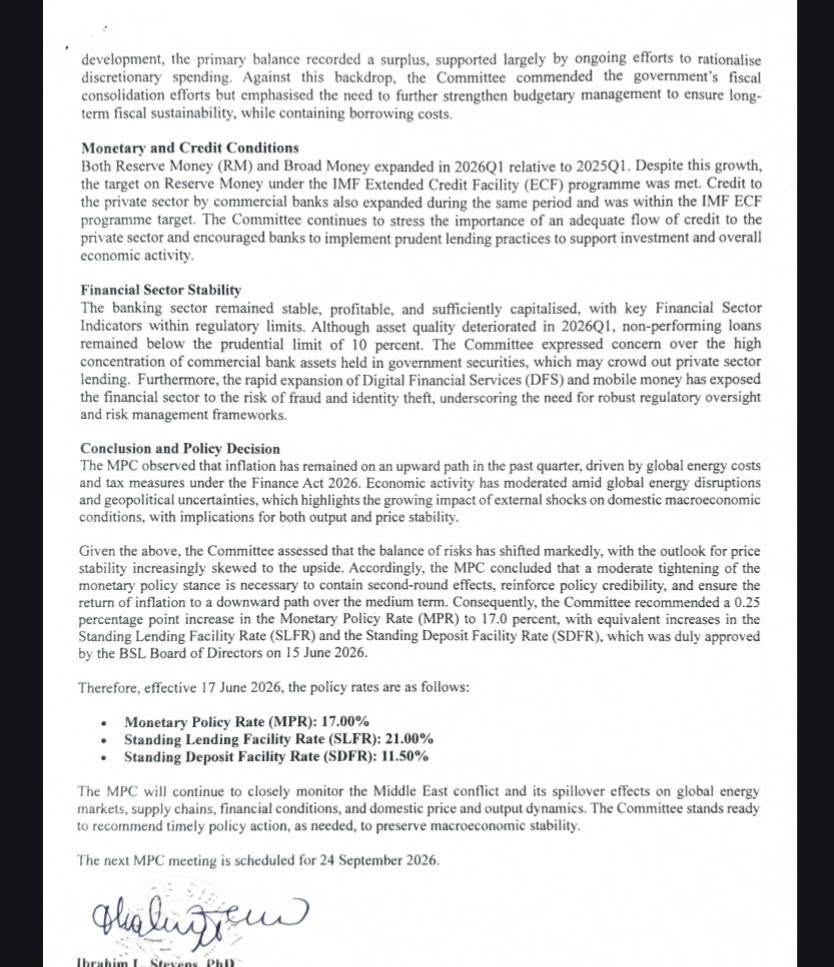
The Bank of Sierra Leone has increased its Monetary Policy Rate (MPR) by 0.25 percentage points to 17.0 percent, citing rising inflationary pressures and heightened global uncertainty driven by geopolitical tensions in the Middle East.

The decision, reached by the Monetary Policy Committee (MPC) at its meeting on 12 June 2026 and approved by the Bank’s Board of Directors on 15 June, took effect on 17 June 2026. The Standing Lending Facility Rate and Standing Deposit Facility Rate were also adjusted upwards to 21.0 percent and 11.5 percent, respectively.

Governor Dr. Ibrahim L. Stevens chaired the MPC meeting, where members reviewed recent global and domestic macroeconomic developments and assessed risks to inflation and growth.

The Committee noted that the global economic outlook has become increasingly uncertain, largely due to geopolitical tensions in the Middle East. The disruption of energy supply routes, particularly the closure of the Strait of Hormuz, has adversely affected global energy markets, increased shipping costs, and weakened investor confidence.

The International Monetary Fund, in its April 2026 World Economic Outlook, revised global growth projections downward to 3.1 percent for 2026, from 3.3 percent projected in January. Inflationary pressures have intensified globally, driven by rising crude oil prices, higher food costs, and elevated transportation costs.

Headline inflation in Sierra Leone has continued its upward trajectory since the first quarter of 2026, increasing from 8.05 percent in February to 10.24 percent in March and 10.83 percent in April. The Committee attributed this to pass-through effects from higher global oil prices and tax measures introduced under the Finance Act 2026.

The MPC assessed that risks to the inflation outlook remain tilted to the upside, particularly amid persistent external cost pressures.

Domestic economic activity is expected to moderate, with real GDP growth projected at 4.0 percent in 2026, down from 5.0 percent in 2025. The moderation reflects the adverse impact of disruptions in global energy markets and their transmission to domestic production through higher input costs and supply constraints.

The Bank’s high-frequency Composite Index of Economic Activities indicated a decline in economic activity in the first quarter of 2026 relative to the previous quarter. However, a gradual recovery is expected, supported by the Feed Salone Programme and other pro-growth government initiatives.

External sector performance improved in the first quarter, with a reduction in the trade deficit driven by significantly lower import bills. Gross international reserves declined but remain adequate to cover approximately 2.1 months of imports of goods and services. The exchange rate remained broadly stable.

The overall fiscal deficit widened in the first quarter of 2026 compared to the same period in 2025, largely due to lower government revenue and a slight increase in expenditure. However, the primary balance recorded a surplus, supported by efforts to rationalise discretionary spending.

Both Reserve Money and Broad Money expanded in the first quarter relative to 2025, though the Reserve Money target under the IMF Extended Credit Facility programme was met. Credit to the private sector also expanded and remained within programme targets.

The banking sector remained stable, profitable, and sufficiently capitalised, with key financial indicators within regulatory limits. Non-performing loans remained below the prudential limit of 10 percent, though asset quality showed some deterioration.

The Committee expressed concern over the high concentration of commercial bank assets held in government securities, which may crowd out private sector lending. Additionally, the rapid expansion of Digital Financial Services and mobile money has exposed the sector to fraud and identity theft risks, underscoring the need for robust regulatory oversight.

The MPC concluded that the balance of risks has shifted markedly, with the outlook for price stability increasingly skewed to the upside. A moderate tightening of monetary policy was deemed necessary to contain second-round effects, reinforce policy credibility, and ensure inflation returns to a downward path over the medium term.

The Committee will continue to closely monitor the Middle East conflict and its spillover effects on energy markets, supply chains, financial conditions, and domestic price and output dynamics.

“The MPC stands ready to recommend timely policy action, as needed, to preserve macroeconomic stability,” the statement read.

The next MPC meeting is scheduled for 24 September 2026.


Source link

Bank of Sierra Leone Announces Reduction in Monetary Policy Rate to Boost Economic Growth


The Monetary Policy Committee (MPC) of the Bank of Sierra Leone (BSL) has reduced the Monetary Policy Rate (MPR) by 1 percentage point to 23.75%, effective June 24, 2025, in a move aimed at lowering borrowing costs and stimulating private sector investment.

The decision, approved by the BSL Board of Directors on June 23, follows a review of global and domestic economic conditions. Governor Dr. Ibrahim L. Stevens announced corresponding adjustments to the Standing Lending Facility Rate (SLFR) and Standing Deposit Facility Rate (SDFR), now set at 26.75% and 17.25%, respectively.

The MPC’s decision comes amid a cautiously optimistic outlook for Sierra Leone’s economy, underpinned by a significant decline in domestic inflation from 13.78% in December 2024 to 7.55% in May 2025. This drop, attributed to prudent monetary policies, fiscal discipline, stable fuel prices, and a relatively steady exchange rate, has created room for the BSL to ease monetary policy to support investment and growth.

Globally, the economic landscape remains challenging, with the International Monetary Fund (IMF), the Organisation for Economic Co-operation and Development (OECD), and the World Bank revising down their 2025 global growth forecasts to 2.8%, 2.9%, and 2.3%, respectively. These downgrades reflect trade policy shifts and geopolitical tensions, which could disrupt supply chains and exert inflationary pressures on Sierra Leone’s economy. Despite these risks, the MPC noted that global inflation is expected to decline in 2025 and 2026 due to tighter monetary policies and falling commodity prices.

Domestically, Sierra Leone’s economy is projected to grow by 4.5% in 2025, up from 4.0% in 2024, driven by strong performances in mining, agriculture, and services. The MPC anticipates growth to rise further to 4.7% in 2026 and 2027, supported by government initiatives to enhance agricultural productivity. However, external risks such as global supply chain disruptions and trade tensions could pose challenges, prompting calls for policies to bolster economic resilience.

The MPC highlighted mixed developments in Sierra Leone’s external and fiscal sectors. The trade deficit widened in the first quarter of 2025 due to higher import costs and lower export earnings, while foreign exchange reserves fell to cover just 1.8 months of imports. On the fiscal front, the budget deficit grew in early 2025 due to lower domestic revenue and higher interest payments, though reduced spending on goods, services, and subsidies narrowed the primary deficit. A decline in the 364-day Treasury Bill rate has eased borrowing costs, providing fiscal space for the government.

Monetary developments showed a contraction in reserve money but moderate growth in broad money (M2) in the first quarter. While credit to the private sector increased, it remains insufficient to drive significant investment. The MPC stressed the need for a more inclusive credit environment to support private sector growth.

In its statement, the MPC emphasised that the rate cut aims to encourage private sector credit, reduce borrowing costs, and promote sustainable growth while maintaining vigilance over inflationary risks. The next MPC meeting is scheduled for 25 September 2025.


Source link

Bank of Sierra Leone Raises Monetary Policy Rate to 21.25%


The Bank of Sierra Leone has announced a hike in the Monetary Policy Rate (MPR) by 2 percentage points, increasing it to 21.25 percent.

This decision was revealed in a recently published document following a meeting of its Monetary Policy Committee (MPC) on 28 September 2023. The meeting was chaired by the Acting Governor, Dr. Ibrahim L. Stevens.

The document noted, “After an assessment of recent macroeconomic and financial developments in the global and domestic economy and the implications for domestic inflation and growth, the MPC decided to raise the Monetary Policy Rate (MPR) by 2.0 percentage points, to 21.25 percent.”

In explaining the rationale behind this decision, the Bank of Sierra Leone pointed to several factors. Global economic developments, inflation rates, domestic economic activities, fiscal development, as well as the state of money, banking, and financial system stability were all cited as significant considerations that influenced the monetary stance.

The document went on to emphasize the challenges of inflation, stating, “Inflation remains a serious and persistent challenge and there are upward risks to the outlook for inflation. These risks include further hikes in fuel and transportation costs, exchange rate depreciation, expansion in monetary aggregates, the continuous rise in the price of imported commodities, and inflation expectations. Given these risks and the level of persistence, the MPC is of the view that the stance of monetary policy going forward has to be contractionary (tight) over the next few quarters.”

More on this document could be read below:


Source link